
Before My First Client
The setup that gave me confidence before taking clients
The pressure from social media groups and YouTube videos can be overwhelming. The constant “how do I get bookkeeping clients” conversations make it feel like that should be your very first step. I want to gently push back on that idea.
Getting clients should not be the first thing you focus on. Bookkeeping clients will come. Trust me. Trust the process.
I was driving the other day to a local moms-in-business networking group and started paying attention to my surroundings. On that short drive alone, I passed easily close to 200 businesses. Along the way, I saw only two CPA firms.
Think about your own life for a moment. Think back to childhood, school, your personal network. How many business owners have you known over the years? Now, how many bookkeepers did you come across?
The point is simple. There are not enough of us.
We are the little fish in a very big sea, which means there will always be a need for good bookkeepers.
One entrepreneur I’ve consistently enjoyed listening to throughout my journey is Codie Sanchez from Contrarian Thinking. One quote of hers has stuck with me in particular:
“Stop saying you want success. Start acting like it. Set aside the distractions and start stacking the reps that satisfy your future self.”
That quote helped me clarify what I needed most at the beginning. I didn’t need perfection. I needed to feel legitimate, prepared, and confident before saying yes to my first client. I needed an intentional setup.
Making it official on paper
I knew I needed a clear separation between myself and my business. So the first step I took was forming my LLC in my home state.
In Florida, this is done through the Florida Sunbiz website (and no, you don’t need to pay another software company to do this for you). For me, this step took the longest, about two weeks, which I would imagine varies state-by-state.
There’s a statistic out there that says entrepreneurs who take the simple step of officially forming an LLC are far more likely to actually follow through with building the business, instead of leaving it as something they “want to start someday.”
For me, this was the first real piece of the puzzle. It shifted my mindset from idea to execution.
After forming the LLC, I registered for an Employer Identification Number (EIN) with the Internal Revenue Service (again, no need to pay another software company to do this for you). This process was fairly quick, instantaneously if I recall correctly. From there, I obtained the required business license for my county, which may or may not apply depending on where you live.
This part of starting a bookkeeping business is not glamorous, but it is essential. These steps lay the groundwork for everything that comes next, including opening the right business accounts and setting your systems up properly from the start.
Opening a business banking account early
If you’re here as a bookkeeper, you already know how important it is to separate business and personal finances. Opening a business bank account early ensured that any money I spent was clearly tied to the business, and it kept my bookkeeping clean from day one.
I initially started with QuickBooks Checking because, as a QuickBooks ProAdvisor, it made sense. There were no monthly fees, no minimum balance requirements, and it was a practical option for someone just starting out who wanted to keep expenses low.
As my business evolved, I realized I needed easy Zelle functionality for the networking groups I was attending. Once I had enough monthly recurring revenue to meet the threshold for the monthly fees to be waived, I switched to Chase Business Banking for flexibility and practicality.
There is no perfect bank. There is a right bank for the season you are in, and it’s okay for that to change as your business grows.
You’re not making sales as a bookkeeper. You’re building client relationships.
Becoming a QuickBooks ProAdvisor
At some point early on, I knew I needed to decide how I was going to work inside QuickBooks Online with real clients.
I want to be very clear about something upfront.
The QuickBooks Online ProAdvisor Program is not going to teach you everything you need to know about accounting. It does not replace formal education, real-world experience, or professional judgment.
And here is the part no one really talks about.
Your clients are not going to care.
Not one client has ever asked me which QuickBooks certifications I hold. What they care about is whether their books are accurate, whether their questions get answered, and whether they feel supported and confident in their numbers.
The reason for this is simple. Most of the entrepreneurs you will work with have already done some version of their own bookkeeping.
They opened the bank account. They connected QuickBooks. They categorized transactions. Some did it fairly well. Most did not. But almost all of them reached the same conclusion eventually.
“I can do this. I just do not have the time.”
From the client’s perspective, bookkeeping is familiar. They have been inside the software. They know what it takes to keep things moving, even if it is not perfect. So when they hire a bookkeeper, they are not looking to be impressed by certifications. They are looking for relief.
I also want to add some context from my own background here.
I have a Master’s in Accountancy and spent a few years in Big 4 public accounting. And yet, nothing in my formal education taught me how to do day-to-day bookkeeping for small businesses. Nothing taught me how to use QuickBooks Online.
That part of my skill set was entirely self taught. Through hands on experience, trial and error, real client files, and learning the software by actually working inside it.
That is true for most bookkeepers, regardless of their credentials.
That said, the ProAdvisor program does serve an important purpose.
It teaches you how to navigate through QuickBooks Online itself. How the software is structured, where things live, how reports flow, and how different features connect. That matters, especially when you are brand new and trying to orient yourself inside the system.
Is it the only way to learn this? Absolutely not.
You can learn QuickBooks Online on the job, through hands on experience, and through countless free tutorials available online. And now, with AI tools, you can often troubleshoot issues, understand workflows, and solve problems quickly when you get stuck.
The value of the ProAdvisor program was never that it was the only path. It was that it offered a guided starting point.
Beyond that, it gave me access to QuickBooks Online Accountant, which is crucial if you plan to work with multiple clients. Being able to switch between files seamlessly, manage client access properly, and work from a centralized dashboard made the backend of my business feel professional from day one.
It also comes with practical benefits. Client discounts, software perks, training resources, and optional participation in their revenue sharing program if that is something you want to explore.
I also want to be transparent here. At the time of writing this post, I have not made a single dollar from revenue sharing. It was never the reason I signed up. If that changes down the road, I will share more about that experience when it actually matters.
For me, the ProAdvisor program was not about proving anything to clients. It was about giving myself the confidence that I understood the software, had the right access, and was set up to support clients responsibly.
That foundation mattered far more than rushing to get clients.
Visual Identity and First Impressions
Early on, I made a conscious decision to keep my branding simple and intentional. I chose a five color palette made up of two core brand colors, two neutral tones, and one accent color. I also selected typography that felt aligned with the brand I was building, one font for headings and one for everything else. Having those decisions made early helped me stay consistent across my website, emails, documents, and marketing materials.
Nothing was rigid or perfectly defined from day one. Some elements evolved over time as the business grew and became clearer. But having a starting point mattered. It removed decision fatigue and gave everything I created a cohesive feel, even in the early stages.
First impressions matter more than we realize, even subconsciously. I know I’m not the only one who thinks this way.
When I’m communicating with a business owner who uses an @gmail.com email address, there is a small, subconscious part of me that questions how seriously they take their business. That judgment may not be fair, and it certainly doesn’t reflect the person’s character or ability, but it can still influence perception.
And when it comes to finances, perception matters.
Most business owners are not going to hand over access to their financial information without trust. Building that trust starts with small details. One of the easiest ways to do that is securing a domain name and setting up a professional email address like name@yourbusiness.com.
Google Workspace quickly became one of my favorite tools. I run my spreadsheets through Google Sheets, store files securely in Google Drive, share receipts and outstanding items with clients, and host client meetings through Google Meet. All for a relatively low-cost for the amount of resources you get within Google Workspace.
As my client base grew, I upgraded to access additional features like calendar booking, so clients could schedule calls easily, and e-signatures for smoother workflows.
If I were to piece together these tools across multiple standalone platforms, it would easily cost over $100 per month and multiple platforms not seamlessly working together. For a service-based business like bookkeeping, that just didn’t make sense early on. Google Workspace allowed me to keep things simple, professional, and cost-effective. Using my referral link will also save you 10 percent for the first 12 months.
I’m also a Squarespace Circle Silver Member. That means I can pass along additional savings when it comes time to build a website. If you’re looking for a place to start, I offer Squarespace websites designed specifically for bookkeepers, whether you prefer a DIY option or a more customized approach. If a custom option sounds like a better fit, feel free to reach out.
Creating a Google Business Profile and Why It Matters More Than You Think
There is one foundational step I did not take early enough, and it cost me my very first potential client.
I had the website. I had the systems. I could clearly articulate my mission, my process, and how I supported clients. The lead loved everything about the business, understood the value, and aligned with what I was building.
But he ultimately decided not to move forward for one simple reason.
I did not have a single review.
At the time, I underestimated how important a Google Business Profile was for a service-based business, especially one built on trust. I assumed reviews would come later, once I had more clients. In reality, reviews are often the very thing that helps someone feel safe enough to become your first client.
A Google Business Profile is not just for storefronts or brick-and-mortar businesses. It is one of the strongest signals of legitimacy for local service providers, including virtual bookkeepers.
When someone searches your business name or searches for a service like “bookkeeper near me,” your Google Business Profile is often the first thing they see. Even before your website.
It shows that your business exists. That it is registered. That it serves real people. And eventually, that others trust you enough to leave feedback.
From an SEO standpoint, this matters more than most people realize. A completed and active Google Business Profile helps your business appear in local search results and map listings. It connects your business name, location, website, and services in a way search engines understand clearly.
From a human standpoint, it matters even more.
When someone is deciding whether to hand over access to their financial information, they are looking for reassurance. Reviews provide social proof. They reduce perceived risk. They answer the unspoken question of “Has anyone else trusted this person and had a good experience?”
You do not need dozens of reviews to start. One thoughtful, honest review can make a meaningful difference. That first review often becomes the bridge between interest and action.
Setting up a Google Business Profile early gives you a place to send clients when the time comes. It allows you to build credibility gradually instead of scrambling later. And it ensures that when someone searches your name after a conversation, they find confirmation instead of uncertainty.
If I could go back and change one thing in my early setup, this would be it. I would have claimed my Google Business Profile sooner and asked my first client for a review as soon as it felt appropriate.
Confidence comes from knowing you are prepared. Trust comes from being visible and verifiable. This small step supports both.
Bringing it back to the bigger picture
None of these steps brought me a client overnight.
What they did give me was confidence. Confidence to show up as a professional. Confidence to say yes when the opportunity came. Confidence that when someone trusted me with their finances, I was ready.
Before the first client ever signed on, my business already felt real. The systems were in place. The structure existed. I wasn’t scrambling to figure things out as I went.
Marketing came later. Networking came later. And once the first client said yes, everything moved a lot faster than I expected.
That will be the focus of the next post.
For now, if you’re in the early stages and feeling pressure to “just get clients,” let this be your reminder that building the foundation first is not wasted time. It’s the work that makes everything else easier.
If you’d like a heads-up when a new post goes live, you can subscribe below.
No pressure and no frequent emails. Just occasional updates when something new is published.
Resources mentioned in this post
• Google Workspace – professional email, file storage, and client collaboration
• Squarespace Websites – as a Squarespace Circle Silver Member, I can pass along savings
• Chase Business Banking – flexibility for payments as your business grows
The Modern Bookkeeper Template
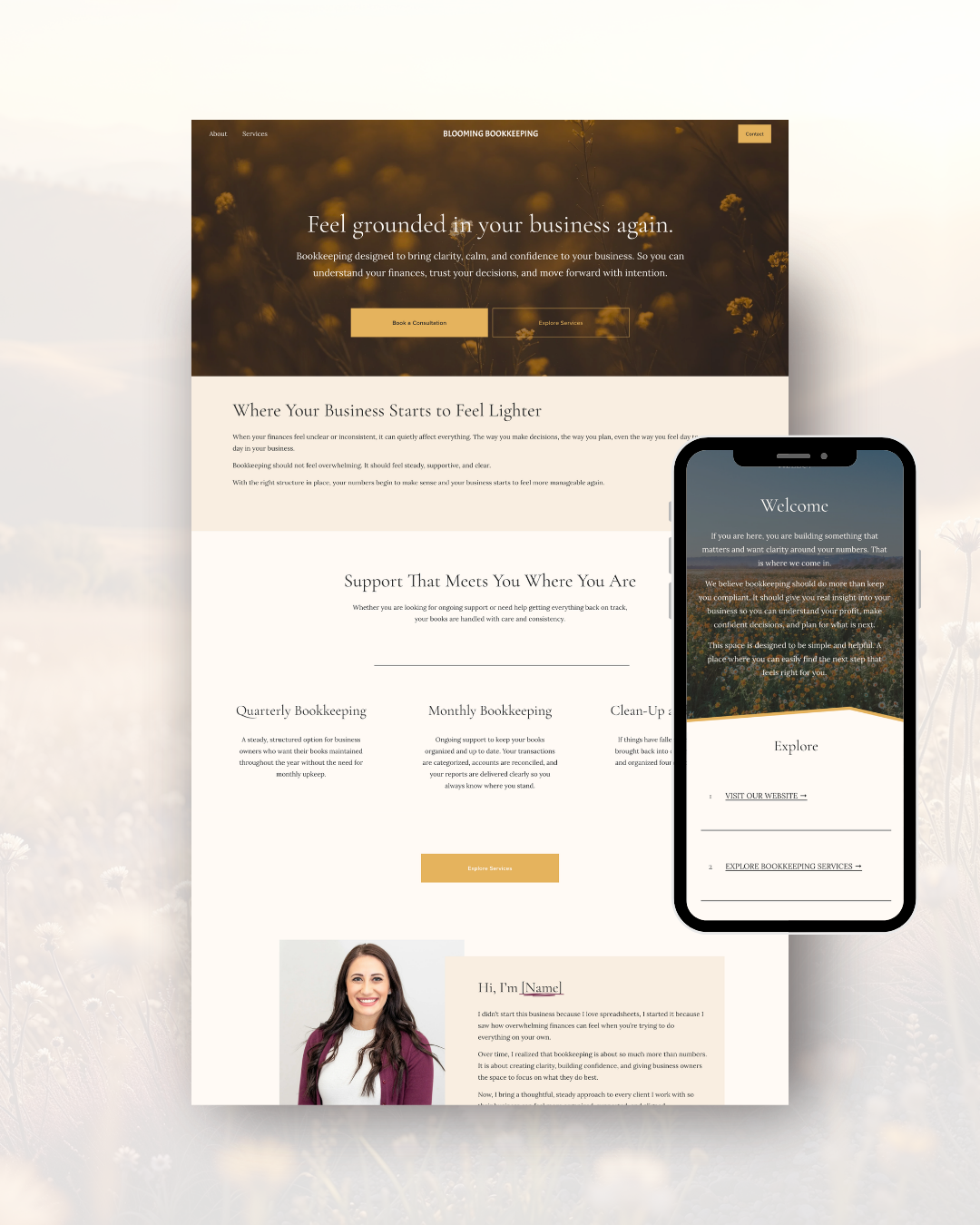
The Modern Bookkeeper Template is a clean, refined Squarespace 7.1 website template designed for bookkeepers, accountants, and financial professionals who want their online presence to feel structured, professional, and effortlessly credible.
Inspired by a modern, editorial aesthetic, this template combines rich tones, balanced layouts, and intentional typography to create a strong and confident first impression. The design leans into simplicity and clarity, allowing your services, expertise, and messaging to stand out without distraction.
Every section is thoughtfully organized to guide potential clients through your offerings with ease. From clearly defined service tiers to a structured “How It Works” flow and a polished personal introduction, the experience is designed to feel both informative and seamless.
Built within Squarespace, the template is fully customizable so you can apply your own branding, imagery, and messaging throughout. Whether you are launching your bookkeeping business or refining an existing brand, this template provides a professional foundation that feels elevated without being overcomplicated.
From homepage to contact page, each detail is designed to support clarity, trust, and a streamlined client experience so your website works for you from the moment it goes live.
What’s included
Your purchase includes a three month free trial with Squarespace, giving you time to customize and launch your site without immediate platform costs. You will also receive human support throughout the setup process to ensure your template is delivered and installed smoothly.
This template includes all essential pages to launch your bookkeeping website with confidence:
Home page
About page
Bookkeeping FAQ page
Instagram links page
Contact page
Each page is pre-structured and designed for clarity, making it easy to plug in your content and go live with confidence.
View the demo
Explore the Modern Bookkeeper Template to see the layout, flow, and overall aesthetic in action before purchasing.
View Demo Site
the-modern-bookkeeper.squarespace.com
Password: demo