
Catch-Up vs. Clean-Up Bookkeeping: Which Service Does Your Business Need?
If you've opened QuickBooks Online recently and thought, "I don't even know where to start," you're not alone. Maybe you haven't touched your bookkeeping in months, or maybe you've been keeping up with transactions but your financial reports still don't make sense. Either way, you know something needs attention, but figuring out what kind of help you need can be confusing.
That's where catch-up and clean-up bookkeeping come in. Although the terms are often used interchangeably, they solve two different problems. Understanding the difference can help you figure out what your business needs to get back on track.
What Is Catch-Up Bookkeeping?
Catch-up bookkeeping is the process of bringing overdue financial records up to date.
Maybe you started the year with every intention of keeping your books organized, but business picked up and bookkeeping kept getting pushed aside. Before you know it, several months have passed, transactions are piling up, and you're not entirely sure where your business stands financially.
Catch-up bookkeeping focuses on recording missing transactions, reconciling accounts, and preparing financial reports for periods that haven't been completed.
Signs You Need Catch-Up Bookkeeping
You might need catch-up bookkeeping if:
You have several months of uncategorized transactions in QuickBooks.
Your bank or credit card accounts haven't been reconciled.
Your payroll activity hasn't been recorded properly.
You haven't reviewed your financial reports in months.
Tax season is approaching, but your bookkeeping isn't finished.
And you don't have to be six months or a year behind to need help. Even a few months of missing bookkeeping can create problems, especially if your business processes a high volume of transactions.
The goal is to bring everything current so you can start making decisions using reliable financial information.
What Is Clean-Up Bookkeeping?
Clean-up bookkeeping focuses on correcting financial records that have already been entered but aren't necessarily accurate.
You might be logging into QuickBooks regularly, categorizing expenses, and keeping up with your bank feed. Everything looks relatively organized on the surface, but that doesn't always mean the underlying financial information is correct.
For example, you could have transactions recorded twice, loan payments categorized entirely as expenses, or income recorded incorrectly because of how your payment processor connects to QuickBooks.
Clean-up bookkeeping involves reviewing those records, identifying errors, and making corrections so your financial reports accurately reflect your business.
Signs You Need Bookkeeping Clean-Up
You might need clean-up bookkeeping if:
Your chart of accounts contains duplicate or unnecessary categories.
Your bank balances in QuickBooks don't match your actual statements.
Income is being recorded incorrectly or duplicated.
Your Square, Stripe, or other payment processor clearing accounts have unexplained balances.
Loan payments, transfers, or owner transactions have been categorized incorrectly.
Your Profit and Loss or Balance Sheet doesn't seem accurate.
One of the biggest misconceptions about QuickBooks is that connecting your accounts means your bookkeeping is being handled automatically.
QuickBooks is a tool, but it still needs someone to review the information going into it. Just because a transaction has been categorized doesn't necessarily mean it's been categorized correctly.
And when those small mistakes happen repeatedly, they can affect your financial reports for months.
Catch-Up vs. Clean-Up Bookkeeping: What's the Difference?
The easiest way to think about it is this: catch-up bookkeeping addresses what's missing, while clean-up bookkeeping addresses what's incorrect.
Catch-Up BookkeepingClean-Up BookkeepingFocuses on overdue bookkeepingFocuses on inaccurate bookkeepingRecords missing transactionsCorrects existing transactionsBrings reconciliations currentFixes reconciliation discrepanciesCompletes missing financial reportsImproves the accuracy of financial reportsGets your books up to dateGets your books organized and reliable
Both services are important, but they address different needs.
You can have bookkeeping that's completely up to date and still inaccurate. You can also have older bookkeeping that's accurate but simply hasn't been completed for the most recent months.
That's why understanding where your books stand is the first step.
Can You Need Both Catch-Up and Clean-Up Bookkeeping?
Absolutely. In fact, it's pretty common.
Let's say you haven't reconciled your business bank accounts in six months. As we work through those missing months, we discover duplicate transactions, incorrectly recorded transfers, and expenses that were assigned to the wrong accounts.
In that situation, simply categorizing the missing transactions wouldn't solve everything. We'd also need to correct the existing errors to make sure your financial reports are accurate.
The work often happens together. As missing periods are completed, errors are identified and corrected along the way.
The goal isn't just to make QuickBooks look organized. It's to make sure the information inside it is something you can actually rely on.
How to Keep Your Books Organized After Catch-Up or Clean-Up
Once your books are current and accurate, the next step is making sure they stay that way.
That doesn't necessarily mean spending hours in QuickBooks every day. It means developing a consistent routine for recording transactions, reviewing expenses, reconciling accounts, and checking your financial reports.
The right routine depends on your business. A company processing hundreds of transactions each week will need a different approach than a consultant who sends a handful of invoices each month.
But consistency matters regardless of business size.
If you're planning to continue managing your own bookkeeping, having a simple process to follow can make a big difference.
A Little More Structure for Your Books
Keeping your books organized shouldn't be something you only think about at tax time.
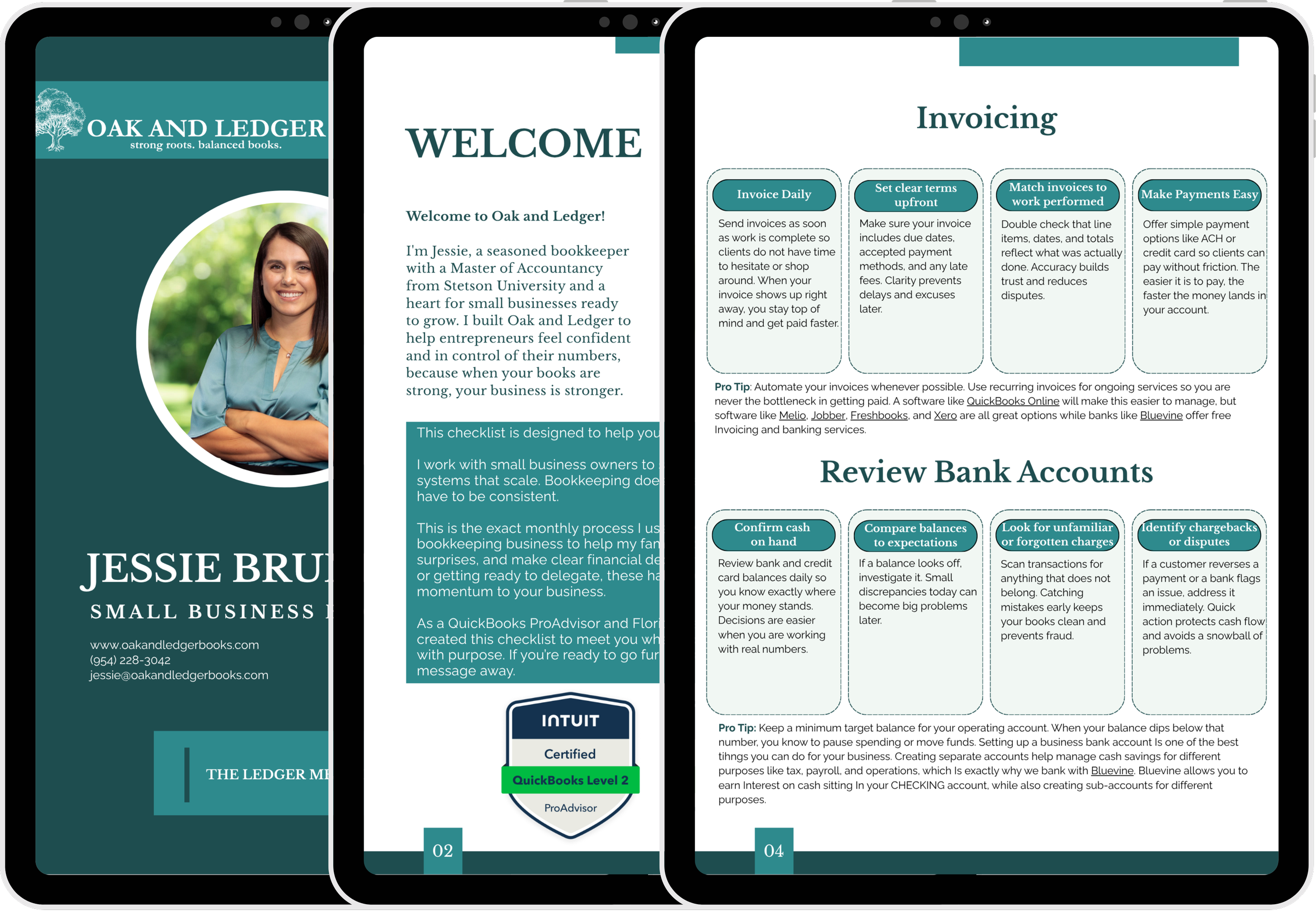
I created The Ledger Method, a free monthly bookkeeping checklist to help small business owners build a more consistent routine. It breaks down the daily, weekly, and monthly tasks that keep your accounts organized, your transactions reviewed, and your financial reports useful.
Whether you're managing your own books or preparing to hand them off, this guide gives you a practical place to start.
Getting Your Books Ready for Year-End and Tax Season
If you're reading this toward the end of the year, now is a good time to address any overdue or inaccurate bookkeeping.
Your tax preparer needs reliable financial information, and unresolved bookkeeping issues can make preparing your business tax return more complicated.
That includes reconciling your accounts, reviewing expenses, confirming loan balances, and making sure income has been recorded correctly.
I've put together a separate article, Year-End Bookkeeping Checklist for Small Business Owners, with practical steps to help you get organized before tax season. It also includes a free 1099 Planner & Guide if your business paid contractors or certain service providers during the year.
You don't have to wait until January to get started.
Need Help Getting Your Books Back on Track?
If you're not sure whether your business needs catch-up bookkeeping, clean-up bookkeeping, or a combination of both, that's okay. You don't need to diagnose every issue before reaching out.
At Oak and Ledger, I work directly with small business owners to review where their books stand, identify what needs attention, and create a plan to move forward.
Whether you're a few months behind or you've been working with inaccurate reports for years, the goal is the same: reliable bookkeeping that helps you understand your business.
And once everything is back on track, we can talk about ongoing monthly or quarterly bookkeeping support so you don't find yourself in the same position next year.